
What Is ‘High-Quality’ Online Education? What Makes a Poor Experience?
Like in-person education, online education should be high quality to ensure that learners are getting the best experiences possible. In this article, we explore what ‘high-quality’ online education really means by outlining the key characteristics that define both high-quality and low-quality online courses.

What makes an online education experience poor?
Unfortunately, many online courses have often “escaped evaluation and oversight” (IIEP, 2023), especially since the COVID pandemic saw an increase in popularity of online learning. Although ‘quality’ can be hard to define, there are certain standards institutions should follow and many tell-tale signs of poor quality that learners look out for when choosing a course. Here are a few:
Missing or vague learning objectives
Without learning objectives, learners are unable to understand what they should be learning from the course and where their abilities should be by the end of it. This not only confuses learners when choosing the course but also leaves them without guidance during the learning process. Similarly, learning objectives that are too vague leave too much room for misinterpretation. Always make sure your online course has one or two clearly defined learning objectives that are communicated from the outset.
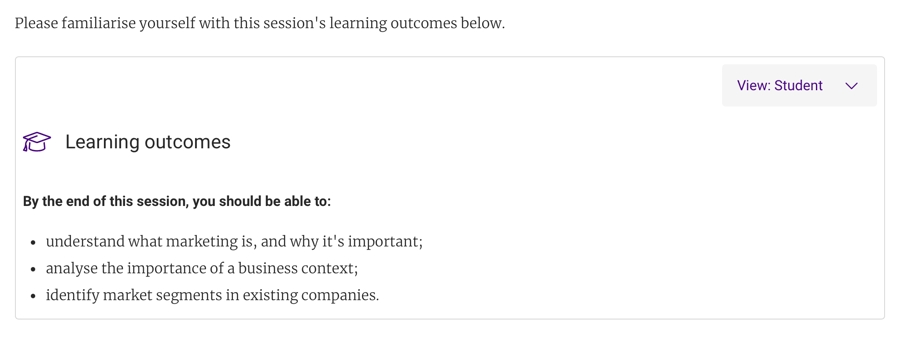
Here is an example of effective learning outcomes using insendi.
Lack of opportunities for collaboration
Online courses should actively encourage collaboration and community building. This could be achieved via group discussions, collaborative projects, and peer-to-peer feedback. A high-quality course will always provide opportunities for building community, since “without it, students are simply learning on their own” (Alvarado, 2020). You can learn more about the importance of community building in online classrooms here.

No/few course materials
Course materials are key to learning and promoting learner autonomy. They encourage learners to become more independent in their education by providing them with supportive documents and activities to use in their own time. A high-quality online program would provide course materials that contain a variety of formats to appease all learning styles, including text-based materials and videos.
Lack of online teaching skills
Despite the increasing popularity of online learning over the past few years, there is still a lack of training for educators teaching online. A high-quality online course provider should ensure that the educators teaching the modules are proficient in online teaching. At the very least, educators should be knowledgeable in online technology and use appropriate tools or integrations, such as an interactive learning tool, to effectively engage learners in an online setting.
Unintuitive learning journey
Many online course providers believe it sufficient to simply upload the materials used in face-to-face teaching onto an online platform or LMS, such as Canvas. However, the learning journey in an online experience differs from that in a traditional classroom, as well as from learner to learner. A high-quality online course will recognise these differences and successfully create a logical, engaging learning journey that moves learners through it at a suitable pace. To achieve this, the best way is to incorporate key learning theories into your course design.

Lack of interactive activities
Any online learning experience must include plenty of opportunities to interact with the course, such as via quizzes, discussion boards, polls, and other engaging features. You can take a look at some great examples of how insendi helps improve interaction in online courses here. When people are engaged in their learning, they switch from absorbing ideas passively to taking in new knowledge and ideas actively. Plus, since “the only reason we learn is so that we can do” (Alvarado, 2020), it’s important that the ‘doing’ begins during the learning process and not only after it.
Sources